 Skyexch
Blackjack Strategy Guide Rules, Odds & Tips
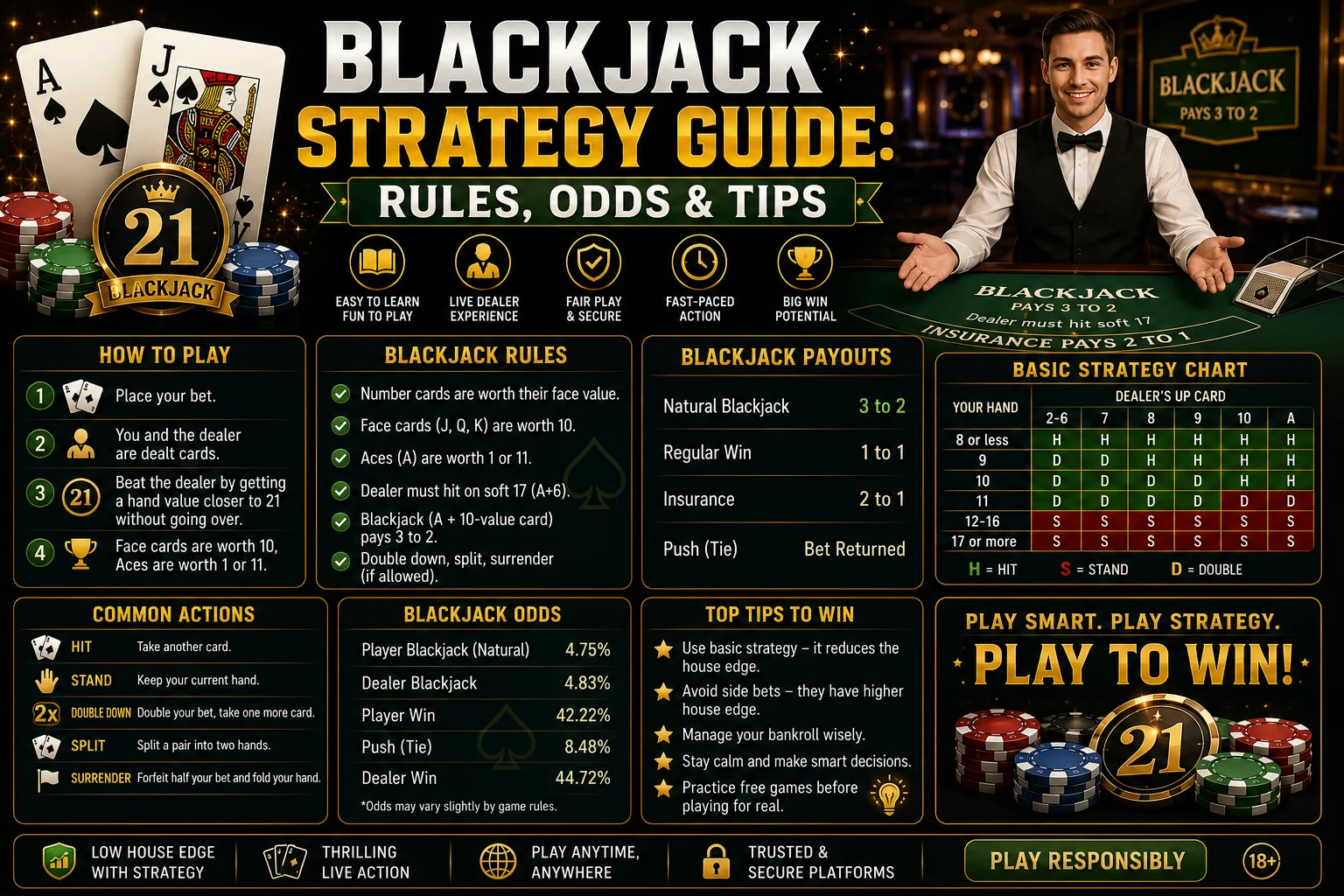 How to Win at Blackjack Strategy, Odds, and Expert Tips
Quick answer: Blackjack is a strategy-based casino table game with one of the lowest house edges available—typically between 5% and 7% for casual players, and as low as 0.5% when basic strategy is applied correctly. Each round lasts just 1–3 minutes, making it one of the most accessible and rewarding games on the casino floor.
Blackjack has been the go-to card game for casino players for centuries—and for good reason. Unlike slots or roulette, the outcome isn't purely a matter of luck. Skill, strategy, and decision-making all play a meaningful role. That combination of accessibility and depth is precisely what keeps millions of players returning to the table.
Whether you're sitting down at a Las Vegas casino for the first time or sharpening your game at an online platform in 2025, understanding how blackjack works—and how to play it well—can dramatically shift the odds in your favor. This guide covers everything you need to know: the rules, the strategy, the math behind the house edge, and the most common mistakes players make.
By the end, you'll have a clear, practical framework for approaching every hand with confidence. skyexch
What Is Blackjack and How Does It Work?
Blackjack is a comparing card game played between one or more players and a dealer. The objective is straightforward: build a hand value closer to 21 than the dealer's hand, without exceeding 21 (known as "busting").
Each card carries a point value:
-
Number cards (2–10): Face value
-
Face cards (Jack, Queen, King): Worth 10 points each
-
Aces: Worth 1 or 11, depending on which value benefits the hand
At the start of each round, players and the dealer each receive two cards. One of the dealer's cards is dealt face up; the other remains hidden until the player completes their turn. Players then choose how to act based on their hand and the dealer's visible card.
What Are the Core Actions in Blackjack?
-
Hit: Request an additional card
-
Stand: Keep your current hand and end your turn
-
Double Down: Double your initial bet and receive exactly one more card
-
Split: If you hold two cards of equal value, split them into two separate hands
-
Surrender: Forfeit half your bet and end the round (available in select games)
A "blackjack"—an Ace paired with a 10-value card—is the strongest hand and typically pays 3:2.
What Is the House Edge in Blackjack?
The house edge in blackjack ranges from approximately 5% to 7% for players who rely on intuition or guesswork. However, when a player applies basic strategy—a mathematically optimized set of decisions for every possible hand combination—the house edge drops to roughly 0.5%, making blackjack one of the most player-friendly games in any casino.
That gap is significant. Playing 100 hands at $10 per hand, a player using guesswork might expect to lose $50–$70 on average, while a basic strategy player would expect to lose around $5.
The specific house edge also depends on game rules:
-
Number of decks: Fewer decks favor the player. Single-deck blackjack offers a lower house edge than six- or eight-deck shoes.
-
Dealer rules: Games where the dealer stands on soft 17 (S17) are more favorable than those requiring a hit (H17).
-
Payout structure: Always avoid tables paying 6:5 for blackjack. The standard 3:2 payout is significantly better for players. sky exchange cricket
How Long Does a Round of Blackjack Take?
A standard blackjack round lasts between 1 and 3 minutes, depending on the number of players at the table and the complexity of decisions being made. At a full table of seven players, rounds run slower. Head-to-head against the dealer, the pace is much faster—sometimes 200+ hands per hour.
This pace makes bankroll management critical. More hands per hour means your total exposure to the house edge increases, so session length matters just as much as individual decisions.
What Is Basic Blackjack Strategy and Why Does It Matter?
Basic blackjack strategy is a decision framework derived from statistical probability. It tells players the mathematically optimal action for every combination of player hand and dealer upcard.
Developed in the 1950s by mathematicians Roger Baldwin, Wilbert Cantey, Herbert Maisel, and James McDermott, and later refined by Edward Thorp in his landmark 1962 book Beat the Dealer, basic strategy remains the foundation of all serious blackjack play.
Key Basic Strategy Rules to Know
|
Your Hand |
Dealer Shows |
Recommended Action |
|
Hard 8 or less |
Any |
Hit |
|
Hard 9 |
3–6 |
Double Down |
|
Hard 10 or 11 |
2–9 |
Double Down |
|
Hard 12–16 |
2–6 |
Stand |
|
Hard 12–16 |
7–Ace |
Hit |
|
Hard 17+ |
Any |
Stand |
|
Soft 18 |
9, 10, Ace |
Hit |
|
Pair of Aces |
Any |
Always Split |
|
Pair of 8s |
Any |
Always Split |
|
Pair of 10s |
Any |
Never Split |
Memorizing this table completely eliminates the most costly errors most players make.
Where Is Blackjack Most Popular in 2025?
Blackjack is one of the most widely played casino table games globally. According to the American Gaming Association, blackjack consistently ranks as the most popular table game in the United States, found in virtually every land-based and online casino.
Geographically, blackjack dominates casino floors in:
-
Las Vegas, Nevada – The global epicenter of blackjack, with hundreds of tables across The Strip and downtown
-
Atlantic City, New Jersey – The East Coast's primary casino hub
-
Macau, China – The world's highest-grossing gaming market
-
Online platforms – Sites like DraftKings, BetMGM, and FanDuel now offer live dealer blackjack available across most US states with legalized online gambling
The rise of live dealer blackjack has expanded the game's reach significantly. Players in states like New Jersey, Michigan, Pennsylvania, and West Virginia can access regulated online blackjack tables around the clock in 2025.
What Are the Most Common Blackjack Mistakes Players Make?
Even experienced players fall into habits that quietly erode their bankroll. Here are the most damaging mistakes to avoid:
1. Not Using Basic Strategy Consistently
The most expensive mistake. Deviating from basic strategy based on "gut feeling" converts a 0.5% house edge into 5–7%. Consistency is everything.
2. Taking Insurance Bets
When the dealer shows an Ace, casinos offer an "insurance" side bet. The math doesn't support it. Insurance carries a house edge of approximately 7.4% in a standard six-deck game—statistically, it's one of the worst bets on the table.
3. Playing 6:5 Blackjack Tables
A 6:5 payout on blackjack (instead of 3:2) adds roughly 1.4% to the house edge. Over a session, that difference is substantial. Walk away from any table that offers less than 3:2.
4. Ignoring Table Rules Before Sitting Down
Dealer rules, deck count, and surrender options all affect the house edge. Spending 60 seconds reviewing the table placard before sitting down is worth it.
5. Chasing Losses
Blackjack operates on independent probabilities. A losing streak doesn't make a winning hand "due." Increasing bets after losses—without a structured system—accelerates losses rather than recovering them.
Is Card Counting in Blackjack Legal?
Card counting is a technique where players track the ratio of high-value to low-value cards remaining in the deck, adjusting bet sizes accordingly. Popularized by Edward Thorp and later by the MIT Blackjack Team in the 1980s and 90s, card counting is not illegal under US law—but casinos reserve the right to refuse service to any player they suspect of counting.
High-surveillance environments like Las Vegas casinos actively identify and back off suspected counters. Online and continuous shuffle machines (CSMs) also eliminate the effectiveness of card counting entirely.
For most recreational players, mastering basic strategy provides more practical benefit with far less effort. skyexch review
Frequently Asked Questions About Blackjack
What is the best blackjack strategy for beginners?
The best starting point for beginners is memorizing basic blackjack strategy. Basic strategy is a mathematically proven decision guide that reduces the house edge to approximately 0.5%. Free strategy charts are widely available and legal to use at most casinos.
What does "house edge" mean in blackjack?
The house edge is the statistical advantage the casino holds over the player, expressed as a percentage of the total bet. In blackjack, the house edge ranges from 0.5% (with basic strategy) to 5–7% (without strategy). A lower house edge means more of your money is returned over time.
How many decks are used in a standard blackjack game?
Most casino blackjack games use six or eight decks shuffled together in a "shoe." Single- and double-deck games exist but are less common. Fewer decks generally benefit the player by reducing the house edge slightly.
Can blackjack be played online for real money?
Yes. Regulated online casinos in states like New Jersey, Michigan, Pennsylvania, Connecticut, and West Virginia offer real-money blackjack, including live dealer versions. Always verify that the platform holds a valid state gaming license before depositing.
What is a "soft" hand in blackjack?
A soft hand is any hand containing an Ace counted as 11. For example, Ace-6 is a "soft 17." Soft hands are more flexible because the Ace can revert to a value of 1 if the next card would cause a bust.
Is it better to stand or hit on 16?
This depends on the dealer's upcard. Basic strategy recommends standing on hard 16 when the dealer shows 2–6 (since the dealer is likely to bust), and hitting when the dealer shows 7 or higher. Surrendering hard 16 against a dealer's 9, 10, or Ace is also recommended where available.
What is the difference between blackjack and other table games?
Blackjack stands apart from games like roulette and craps because player decisions directly affect the outcome. Games like roulette are purely chance-based. Blackjack rewards skill—specifically, consistent application of basic strategy—with a materially lower house edge.
Build Your Game, One Hand at a Time
Blackjack rewards preparation. The gap between a casual player and a skilled one isn't talent—it's knowledge. Understanding the house edge, learning basic strategy, choosing the right tables, and managing your bankroll effectively are all learnable skills that shift the math in your favor.
Start with a printed basic strategy chart. Study the rules of the specific game you're playing. Practice with free online simulators before risking real money. And when you sit down at a live table, trust the math over your instincts.
The house will always hold some advantage. But in blackjack, you have more control over that margin than in almost any other casino game. skyexch.help